A New Search Intent Doesn't Need a New Domain
While analyzing search terms across our paid ad campaigns and organic queries this week, we uncovered a fascinating keyword cluster. A large group of users were repeatedly searching for a specialized pre-requisite validation check right before completing a primary transaction.
The conversion potential was unmistakable. These users were not idly browsing. They were standing at the final verification step immediately prior to making a high-intent commitment.
Our initial, excited instinct was immediate: buy an exact-match domain, spin up a clean repository, and launch a dedicated micro-site exclusively for that specific verification step.
It felt productive. But it was the classic multi-domain trap.
Whenever solo builders spot an adjacent search intent, the default reaction is to register another URL. You envision a portfolio of hyper-focused micro-sites, each dominating its own distinct keyword corner.
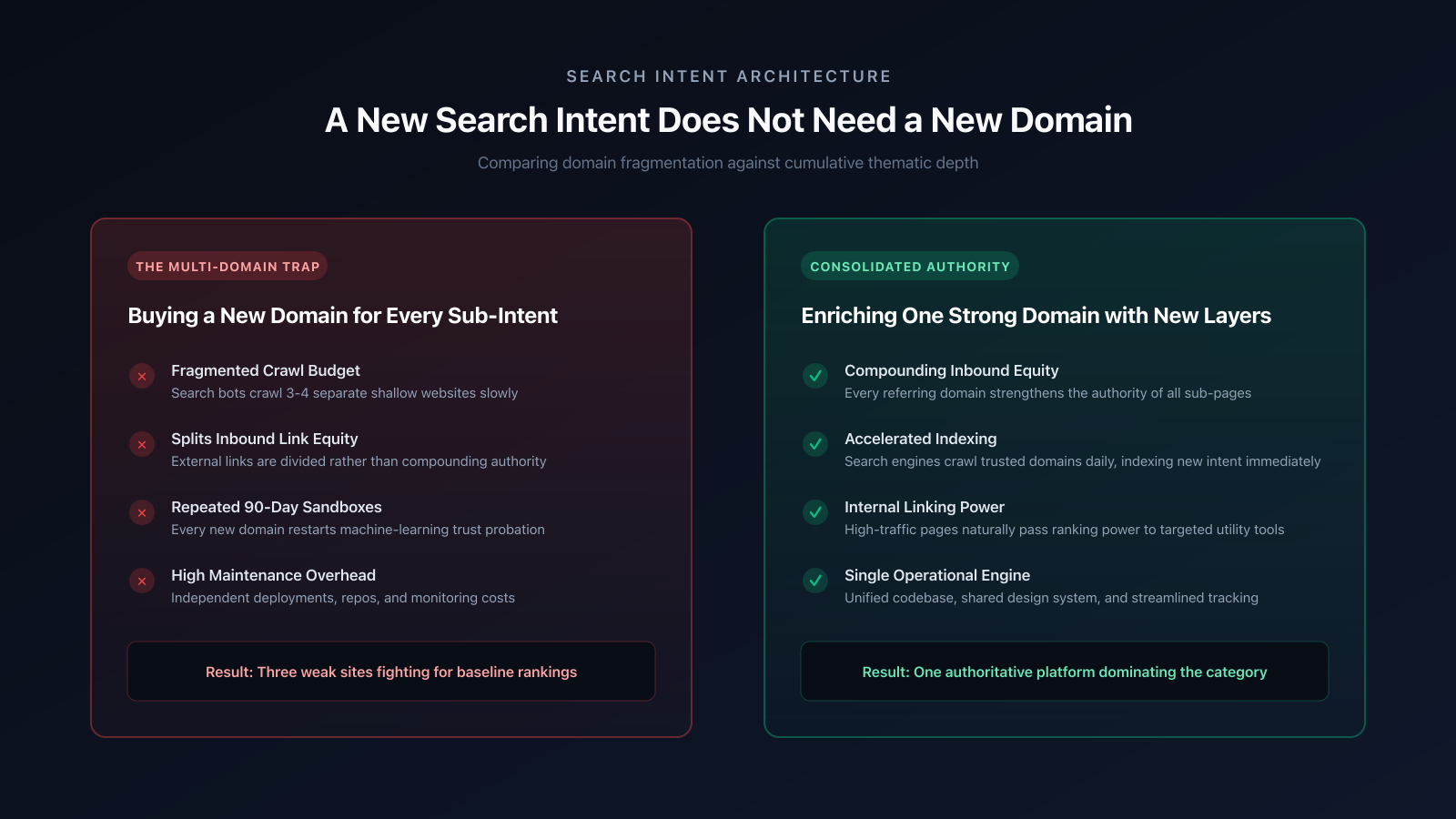
In reality, domain fragmentation actively weakens your position:
First, it divides your link equity. Getting ten high-quality inbound links to one domain gives every subfolder real ranking power. Scattering those same ten links across three separate domains leaves all three underpowered.
Second, it restarts the algorithmic sandbox. A search engine takes 90 to 120 days to observe user signals and establish baseline trust on a fresh domain. Launching a new site forces you to sit through that probation period from day one.
Third, it fragments your attention. You suddenly have three deployment pipelines, three analytics dashboards, three content roadmaps, and three sitemaps competing for limited daily crawl budgets.
The better decision is almost always consolidation.
Instead of launching a separate domain, we integrated that specific verification workflow directly into our primary existing asset. We added dedicated validation sections and regional compliance rules to our existing guides.
The primary site already had crawl trust. The new sections indexed within hours, inherited the domain’s existing authority, and immediately began ranking without starting from scratch.
A new search intent does not need a new domain. It needs dedicated depth on an asset that already has the search engine’s trust.